


1010 N. Howe Street, Southport, NC 28461
OFFICE HOURS | Monday – Friday, 7:00 AM – 4:00 PM
Contact us at (910) 457-7935 (including after-hours emergencies)
TRASH & RECYCLING QUESTIONS: (910) 253-4177
UPCOMING MEETINGS

Electric Service Rates
Rates Effective July 2023
Residential:
Base Rate: $23.00/month
Rate Code: $/kWh
SR0: $0.127
SR1: $0.117
SR2: $0.107
SR3: $0.097
SR4: $0.087
Commercial:
Base Rate: $25.50/month
Rate Code: $/kWh
SC0: $0.127
SC1: $0.117
SC2: $0.107
SC3: $0.097
SC4: $0.087
Commercial Demand:
Base Rate: $75.00/month
Usage: $0.05710/kWh
CP Demand: $32.72/kW
Excess: $2.50/kW (NCP-CP)
Large Commercial Demand:
Base Rate: $75.00/month
Usage: $0.05980/kWh
CP Demand: $26.00/kW
Excess: $4.00/kW (NCP-CP)
Rooftop Solar Rates
BUY ALL/SELL ALL
Base Rate: $23.00/month + $3.75
Rate Code: $/kWh
SP15: $0.0665
NET METERED
Base Rate: $28.00/month
Rate Code: $/kWh
SP30: $0.125*
*Load Management Program is applicable


It is possible to save on your electric bill by having a load management switch installed on your electric water heater, central air conditioning system, or heat pump heating/cooling systems.
- There is no cost to install a switch.
- Water heaters are controlled 12 months of the year.
- Air conditioning units are usually controlled from May through October.
- All load management switches are installed by a licensed electrician.
- If you disconnect your load management switch, your electric rate will revert to a higher rate.
Ordinance amending Chapter 19
Article V, of the Southport City Code, Article V. Electrical Service
Sec. 19-186. Load Management.
(a) The building contractor or his plumbing or electrical sub-contractor shall place a Load Management switch provided by the City on all Electric water heaters 40 gallons or larger, as long as they are no more than 9kW, installed in new residential structures before a Certificate of Occupancy is issued. (April 12, 2018)
(b) The building contractor or his HVAC or electrical sub-contractor shall place Load Management switches provided by the City on all compressor and heat strip circuits on all standard 240V Electric Heat Pumps or HVAC units installed in new residential structures (“mini-split” heat pump units and geothermal systems are exempt) before a Certificate of Occupancy is issued. (April 12, 2018)
(c) Property owners, when making application for electrical service to an existing residential property, shall permit installation of load management switches if not already installed and functioning on all compressor and heat strip circuits, on all standard two hundred forty volt (240V) electric heat pumps or HVAC units (“mini-split” heat pump units and geothermal systems are exempt) and on all electric water heaters forty (40) gallons or larger provided they are no more than nine (9) kilowatts before an electrical service account will be granted. (June 11, 2020)
Load Management FAQ
What is Load Management?
Load Management is a practice of shedding loads (turning things off) at critical times when wholesale electricity is at a premium cost to municipalities.
Load Control Devices are installed on consumer and commercial loads that enable the power agency (North Carolina Eastern Municipal Power Agency) to control those loads to assist participating municipalities save on power costs.
What is a Load Control Device
A remote switch, connected via Wi-Fi, or other means, to the power agency. Participants are required to maintain a Wi-Fi connection to the thermostats so that the power agency can control them at peak power times.
How long is my AC condenser cycled off?
Around 15 minutes, twice each hour.
Why does the City of Southport want to control my air conditioner?
To help reduce the City’s demand electric cost.
How does the City’s Load Management Program benefit me and why should I participate?
Participants receive an incremental 1¢/kWh discount on each Load Management tier of participation. A customer with AC, Heat Strip, and Water Heater control pays 9.5¢/kWh (as opposed to 12.5¢).
Participants also get many perks from the smart thermostats such as phone apps and internet connectivity. Imaging coming home early on a hot day and being able to adjust your thermostat down before you get home!
Like other smart thermostats, they are fully programmable with temperature pre-sets based on participants’ work schedules, vacations, etc.
Who is required to have a load management device?
Everyone, under the ordinances of 2018 and 2020. The use of Load Management is now required on all new construction and for all new accounts. For anybody else that isn’t signed up, opting in is still voluntary.
Can I opt out of this program?
Participants with City issued Smart Thermostats may opt out of individual events.
What if I want to opt out? What circumstances allow me to opt out?
If someone with Asthma or COPD had an issue with running Load Management, there may be an exception that can occur. At the very least, participants should be able to have Load Management on their water heater.
Can I opt in to enroll just my water heater and/or just my HVAC system?
Some customers have mini-split AC units that we cannot control. We also cannot control any “instant” water heaters.
What does this device look like and where is it located?
The newest switches are rectangular, about 4-1/2 X 8 inches, and can be found in close proximity to water heaters and HVAC equipment.
Are there other options?
The City offers the EcoBee 3 Lite and the EcoBee 4 smart thermostats. The City issues them as an alternative for citizens to be Load Management compliant without installing the usual device control switches.
For this option, participants are responsible for the installation of the smart thermostats within 60 days.
Load Management Participation Form

While mosquitoes cannot be eliminated, it is important to control mosquitoes. They are a known disease “vector” meaning they can transmit some diseases to humans. Even mosquitoes that do not transmit disease can be a nuisance in their biting behavior. In severe instances, it can be detrimental to the city’s quality of life.
Mosquito Vector Control:
David Kelly | Tel: (910) 457-7935
Email
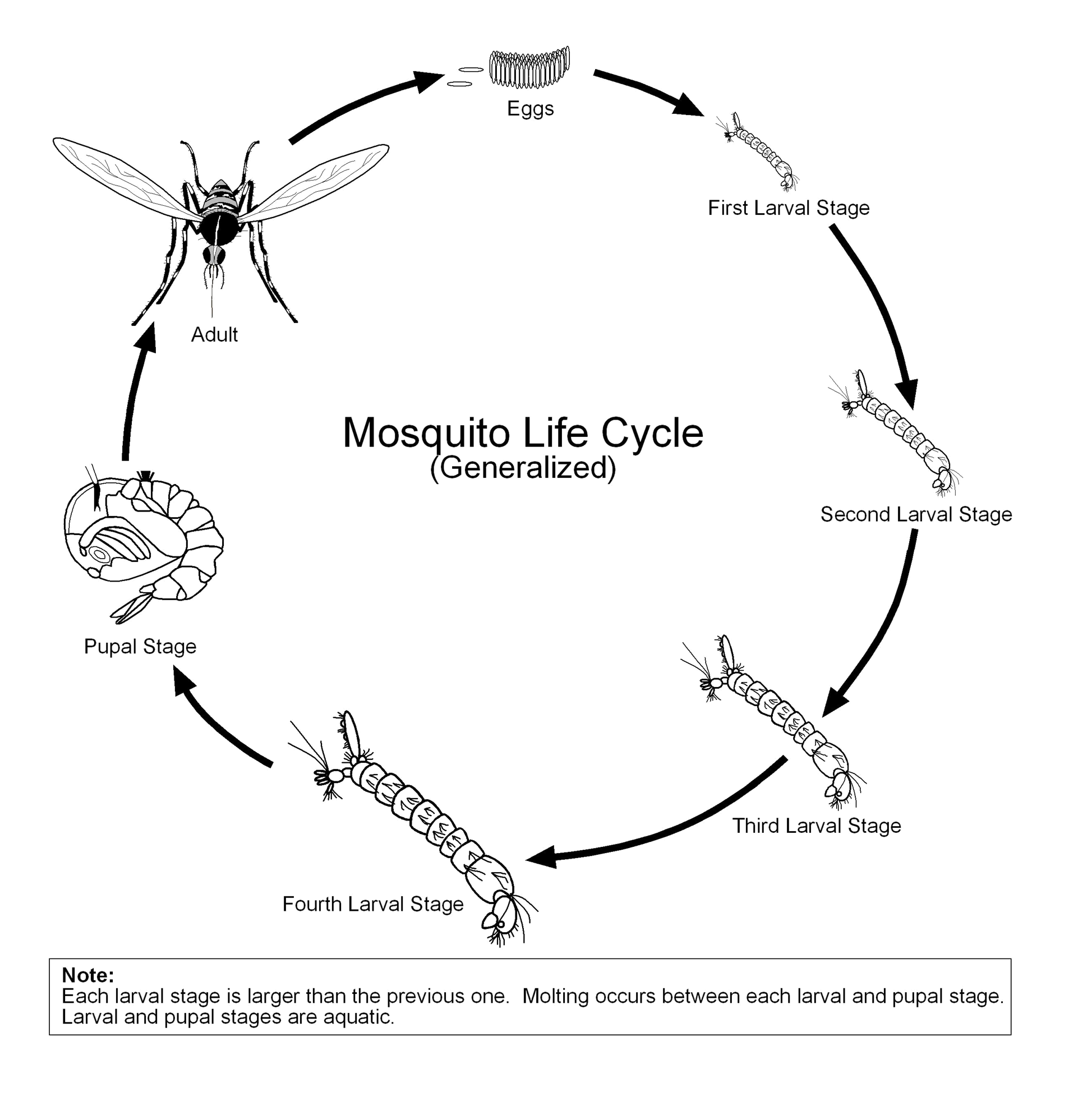
Mosquito Life Cycle
Brunswick County has 47 different mosquito species. Learn more about the mosquito species in Brunswick County.
Knowing the different stages of the mosquito’s life will help you prevent mosquitoes around your home and help you choose the right pesticides for your needs, if you decide to use them. All mosquito species go through four distinct stages during their life cycle:
- Egg – hatches when exposed to water.
- Larva – (plural: larvae) “wriggler” lives in water; molts several times; most species surface to breathe air.
- Pupa – (plural: pupae) “tumbler” does not feed; stage just before emerging as adult.
- Adult – flies short time after emerging and after its body parts have hardened.
The first three stages occur in water, but the adult is an active flying insect. Only the female mosquito bites and feeds on the blood of humans or other animals.
- After she obtains a blood meal, the female mosquito lays the eggs directly on or near water, soil and at the base of some plants in places that may fill with water. The eggs can survive dry conditions for a few months.
- The eggs hatch in water and a mosquito larva or “wriggler” emerges. The length of time to hatch depends on water temperature, food and type of mosquito.
- The larva lives in the water, feeds and develops into the third stage of the life cycle called, a pupa or “tumbler.” The pupa also lives in the water but no longer feeds.
- Finally, the mosquito emerges from the pupal case after two days to a week in the pupal stage.
- The life cycle typically takes up two weeks, but depending on conditions, it can range from 4 days to as long as a month.
The adult mosquito emerges onto the water’s surface and flies away, ready to begin its lifecycle.
Mosquito Spraying
PCT 3+15 ULV is the current product used to manage adult mosquito populations by the city. Our mosquito sprayers are equipped with Smart Flow Technology, providing the driver with increased treatment flexibility, while improving the accuracy of each application. As a precautionary measure, people and pets should go indoors when they see the mosquito sprayer coming.
Typical spray times are between 7:30 p.m. to 11:00 p.m. depending on weather conditions.
There are 5 spray zones in Southport.
Zone 1 (West side of Howe Street) is from West 9th Street to West Bay Street. That includes Indigo Plantation & Cottage Point.
Zone 2 (East side of Howe Street) is from East Leonard Street to East Bay street. That includes The Hammocks, The Landing, Harbor Oaks, & Turtle Wood.
Zone 3 (East side of Howe Street) is from Stuart Ave to East Leonard Street. Includes Park Ave Ext., Highland Park Ave and Price’s Creek.
Zone 4 (West side of Howe Street) is from West 9th Street to West 14th Street. That includes The Ridge & Cades Cove.
Zone 5 is Rivermist
Register your Beehives

Mosquito Prevention Tips for Your Home
Knowing the different stages of the mosquito’s life will help you prevent mosquitoes around your home and help you choose the right pesticides for your needs, if you decide to use them. All mosquito species go through four distinct stages during their life cycle:
- Egg – hatches when exposed to water.
- Larva – (plural: larvae) “wriggler” lives in water; molts several times; most species surface to breathe air.
- Pupa – (plural: pupae) “tumbler” does not feed; stage just before emerging as adult.
- Adult – flies short time after emerging and after its body parts have hardened.
The first three stages occur in water, but the adult is an active flying insect. Only the female mosquito bites and feeds on the blood of humans or other animals.
- After she obtains a blood meal, the female mosquito lays the eggs directly on or near water, soil and at the base of some plants in places that may fill with water. The eggs can survive dry conditions for a few months.
- The eggs hatch in water and a mosquito larva or “wriggler” emerges. The length of time to hatch depends on water temperature, food and type of mosquito.
- The larva lives in the water, feeds and develops into the third stage of the life cycle called, a pupa or “tumbler.” The pupa also lives in the water but no longer feeds.
- Finally, the mosquito emerges from the pupal case after two days to a week in the pupal stage.
- The life cycle typically takes up two weeks, but depending on conditions, it can range from 4 days to as long as a month.
The adult mosquito emerges onto the water’s surface and flies away, ready to begin its lifecycle.


Maintenance Request Form

1010 N. Howe Street, Southport, NC 28461
OFFICE HOURS | Monday – Friday, 7:00 AM – 4:00 PM
Contact us at (910) 457-7935 (including after-hours emergencies)
TRASH & RECYCLING QUESTIONS: (910) 253-4177

Tom Stanley
Public Services Director
Email
(910) 457-7935

Larry Ditton
Energy Manager
Email
(910) 457-7938

David Kelly
Vector Control, Mosquito
Email
(910) 457-7935
Kevin Alley
Garage
Email
(910) 368-3288

Jackie Smith
Office Manager
Email
(910) 457-7935
2023 Southport Symposium featuring Public Services
Let us know how we are doing: