

Upcoming Meetings

Meetings are held on the 1st Wednesday of each month at 4 p.m.
Location: Indian Trail Meeting Hall, 113 W. Moore Street
January 7, 2026 | February 4, 2026 | March 4, 2026 | April 1, 2026 | May 6, 2026 | June 3, 2026 | July 8, 2026 | August 5, 2026 | September 2, 2026 | October 7, 2026 | November 4, 2026 | December 2, 2026
Historic Preservation Committee Mission
When is a Preservation Commission formed?
When a local government decides to provide for the preservation of the historical, cultural, or archaeological resources within its jurisdiction, it can pass an ordinance to create a historic preservation commission. Members of a preservation commission are selected by the local governing board from the general public. A majority of the members must demonstrate a special interest in history, architecture, archaeology, or related fields.
What power does a commission have?
A commission’s primary powers are (1) recommending to the local governing board properties to be designated as historic districts and landmarks and (2) reviewing applications from owners of designated landmarks and structures in historic districts who plan to make changes to their properties. A commission’s first charge is to conduct an inventory of the area’s historic resources. Its other powers include conducting a public education program and acquiring historic properties.
What are some considerations prior to joining a commission?
A Letter to George: How to Keep the Preservation Commission Out of Court and Avoid Being Sued, by Robert E. Stipe. Bob Stipe’s 1994 paper on understanding the responsibilities of a preservation commission and avoiding pitfalls in the work of a commission.
Information obtained from ncdcr.gov.
Historic Preservation Committee Goals
Pursuant to discussions by the Historic Preservation Commission at previous meetings, and multiple conversations between Staff and Chairman Charles Drew, the following draft goals are offered for consideration of adoption by the Historic Preservation Commission as the initial goals for the Commission to follow. The Commission shall have the ability to modify these goals over time.
Goal 2: The City of Southport Historic Preservation Commission shall establish policies and procedures to prevent the loss of historically significant structures within locally designated historic districts.
Goal 3: The City of Southport Historic Preservation Commission will lead efforts to provide education on the benefits of historic preservation to property owners and residents of the City at large.
Goal 4: The City of Southport Historic Preservation Commission shall support public participation in the historic preservation process, including but not limited to publicly initiated nominations of local landmarks and through transparency in Commission actions in accordance with all applicable state statutes.

Historic Preservation Commission Members
| NAME | ADDRESS | CONTACT | APPOINTED | EXPIRATION |
|---|---|---|---|---|
| Charles Drew, Chair | 112 Park Avenue | (910) 477-2365 cdrew@cityofsouthport.com | June 2025 | June 2028 |
| Bonnie Bray, Vice Chair | 515 Quarter Master Drive | (301) 741-6698 blbray@mac.com | June 2025 | June 2028 |
| Alexis Gore Graves | 510 N. Lord Street | (256) 653-1854 alexisgoregraves@gmail.com | June 2025 | June 2028 |
| Bonner Herring | 112 W. Bay Street | (772) 263-1417 bonner@ocean2oaks.net | June 2024 | June 2027 |
| Josh Cline McGee | 195 Gentle Breeze Court | (704) 614-2956 cmadesign7@gmail.com | October 2022 | June 2026 |
| Jim McKee | 114 S. Davis Street | (910) 470-0529 jim.mckee@ncdcr.gov | October 2022 | June 2026 |
| Joanne Wesson | 107 River Watch Lane | (910) 264-4009 river2992955@gmail.com | June 2024 | June 2027 |
| Lewis ‘Tal’ West, Alternate | 6159 River Sound Circle Drive | (704) 575-6048 Tal@multimarketingnc.com | October 2022 | June 2026 |
| Katherine Hufham, Alternate | 40 Forest Oaks Drive | (910) 470-4045 kghufham@bellsouth.net | June 2025 | June 2026 |
| Penny Tysinger, HPC Planner | 1029 N. Howe Street | (910) 457-7925 ptysinger@cityofsouthport.com | ||
| Maureen “Mo” Meehan, Planning Director | 1029 N. Howe Street | (910) 457-7900 ext.1043 mmeehan@cityofsouthport.com | ||
| Scott Baillargeon, Deputy City Clerk | 1029 N. Howe Street | sbaillargeon@cityofsouthport.com | ||
| Lowe Davis, Aldermen Liaison | 1029 N. Howe Street | ldavis@cityofsouthport.com |

Local Historic Property Designations in North Carolina
Local governments in North Carolina–counties and municipalities–can choose to take advantage of state enabling legislation (General Statutes 160A-400.1-400.14) that allows them to create historic preservation commissions and to designate local historic districts and landmarks.
In the statute, the General Assembly sets forth its finding that, “The historical heritage of our State is one of our most valued and important assets. The conservation and preservation of historic districts and landmarks stabilize and increase property values in their areas and strengthen the overall economy of the State.”
What Local Designation IS and IS NOT: Local designation is conferred by a local governing board following a recommendation by its preservation commission. Commissions only exist where they have been explicitly created by the county or city, and only commissions created pursuant to state law can exercise design review over properties designated by the local governing board. However, commissions around the state are known by a few different names: historic resources and preservation commissions work with both districts and landmarks while district commissions work solely with districts, and landmark commissions work solely with landmarks.
The local designation should not be confused with listing in the National Register of Historic Places, which is a federal program administered by the state. Although some properties may carry both types of designation, the National Register and local designation are totally separate programs with different requirements and benefits. Also, local commissions should not be confused with other local historical organizations such as historical societies or museum groups.
Information obtained from ncdcr.gov.
Other Local Historic Preservation Commissions
Over 100 local historic preservation commissions are active across North Carolina. Click on the map pin below to see the contact information for the commission. Certified Local Government commissions have green pins.
View North Carolina Historic Preservation Commissions on a larger map. Click here for a static state map showing participating municipal governments in joint commissions with counties.
Information obtained from ncdcr.gov.
Historic Preservation FAQs
What is a local historic district?
What is a local historic district?
A local historic district is an overlay district considered as part of the zoning ordinance. It is applied by the Board of Aldermen as an area of special significance, in terms of history, prehistory, architecture, and/or culture, that possesses integrity of design, setting, materials, feelings, and association. (as per NC GS § 160D-944)
Why is a local historic district being created?
Through extensive public input in the development of the City’s 2014 CAMA Core Land Use Plan, the preservation of Southport’s history and character was important to the residents of the City. In the plan, there is a recommendation to establish a Historic Preservation Commission. Under state enabling legislation NC GS §160D-941, the Board of Aldermen adopted an ordinance establishing the Historic Preservation Commission in 2022 to administer the City’s Historic Preservation Ordinance. The duties of the Historic Preservation Commission are outlined in Article IV Sec. 2-195. The creation of the Historic Preservation Commission is the first step in protecting the City’s historical character.
How is a local historic district designated?
The designation process began with the Historic Preservation Commission (HPC) adopting rules of procedure and the development of the Historic District Design Standards. Followed by the HPC identifying the proposed local historic district. The HPC conducted a survey of the district to write a local designation report documenting the district’s significance. The Department of Cultural Resources, acting through the North Carolina State Historic Preservation Officer, is given an opportunity to review and comment on the proposed designation. When the HPC receives and addresses comments received from the NCHPO, they may make a recommendation to the Board of Aldermen to adopt the proposed local historic district overlay boundary.
What are historic district design standards?
The Local Historic District Design Standards assist the Historic Preservation Commission, staff, and property owners understand what changes are congruous with the special character of the district. Through text and illustrations, the standards show acceptable alterations, additions, and new construction.
Please review the Local Historic District Design Standards or contact Penny Tysinger at ptysinger@cityofsouthport.comor 910-457-7925.
Is my property located in a historic district?
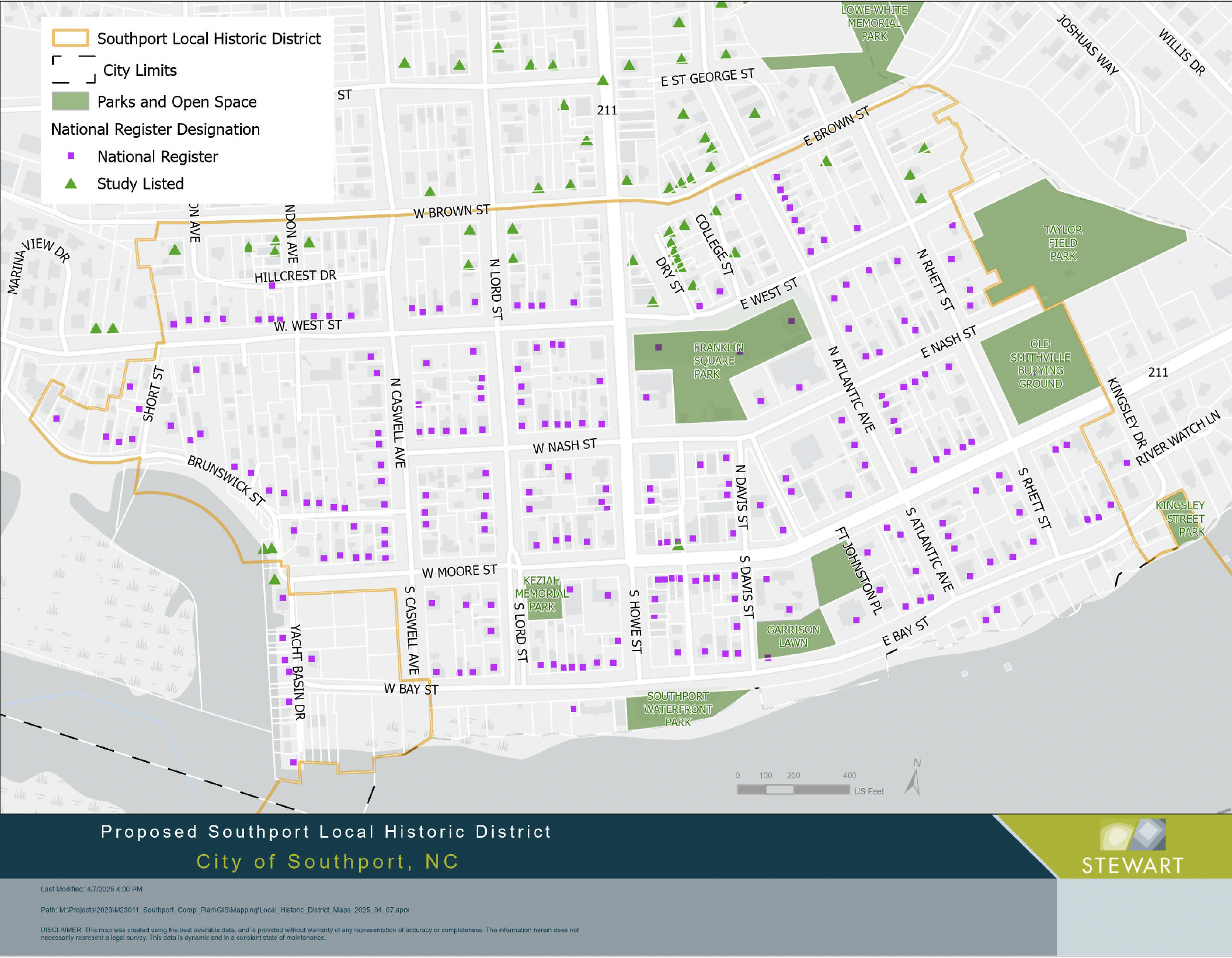
The City of Southport has one large National Register District, the “Southport Historic District” that includes commercial, government, & religious buildings, parks, a cemetery, and private residences. The Southport Historic District was surveyed in the late 1970s and was listed on the National Register of Historic Places in 1980. The City of Southport also has a study listed boundary that was surveyed in 2010. A local district is being proposed which includes the “Southport Historic District” and a portion of the study listed boundary.
Please view the interactive map to determine if your property is located within one of these districts.
What is the difference between a Local Historic District and a National Register Historic District?
The North Carolina General Statutes authorizes the creation of the Historic Preservation Commission and grants certain authority to the HPC. Development in the local historic district must meet design requirements outlined in the Historic District Standards and is required to receive a Certificate of Appropriateness prior to commencing any work. A local historic district offers the most protection.
A National Register historic district is listed in the National Register of Historic Places. Listing in the National Register of Historic Places is mostly honorary, but it does offer some protection to adverse impacts caused by federal or state-funded projects.
What are the benefits of a local historic district?
A local historic district offers the most protection. A local historic district improves property values by stabilizing and enhancing the neighborhood’s character. Its property owners benefit from insensitive changes by other owners that might destroy the special qualities of the neighborhood.
My property is in the local district. Do I need approval for a project?
You will need a Certificate of Appropriateness (COA) for any exterior work. Minor works are reviewed and approved by staff. Major work COAs which involves changes to materials, buildings, and property require approval from the Historic Preservation Commission. More detailed information to come.
What are the benefits of owning a historic property?
Owners of contributing properties in the National Register Historic District may be eligible to apply for federal and state tax credits for the qualifying rehabilitation of income producing properties. Owners and developers may potentially receive a 20% federal income tax credit and a 15-25% state income tax credit for certified commercial rehabilitation of income-producing historic structures. Homeowners of contributing properties in the National Register Historic District may receive a 15% state tax credit for qualified rehabilitation of owner-occupied residential properties.
Will I be required to fix up my building or home?
Nearly all preservation ordinances are reactive rather than proactive, which means there are not requirements on owners to make any repairs. Housing and building codes that apply to all buildings in a jurisdiction may be used to ensure buildings are in a safe and livable condition. There is an option for a demolition by neglect ordinance, which would allow the local government to step in and prevent deterioration if an owner is deliberately letting a building deteriorate so they can tear it down.
Can new buildings be built in a local historic district?
Yes. There are several new buildings that are in the proposed local historic district. The Local Historic District Design Standards includes a section for additions and new construction. New construction is encouraged to be compatible with the existing district, and yet distinct, so that residents and visitors alike can tell that it is a new 21st century building.
Will I have to alter the building to comply with the American with Disabilities Act?
The Americans with Disabilities Act (ADA) does not apply to structures used for residential purposes. The act only applies to structures used for commercial purposes, regardless of the property’s historical status. Non-residential uses in all commercially zoned areas must comply with the Americans with Disabilities Act, which has special provisions for historic structures.
Is there any guidance to make my building more efficient?
Yes. The National Park Service Secretary of Interior’s Standards for Rehabilitation offers several guidelines to assist in making your building more energy efficient or sustainable. If any of alterations are being made to the exterior, please contact Penny Tysinger at ptysinger@cityofsouthport.com or 910-457-7925.
Can I elevate my historic property?
Yes. This will require a Certificate of Appropriateness but there is guidance in the Local Historic Design Review Standards and the National Park Service’s Secretary of Interior’s Standards for floodproofing a historic property.
Will a local historic district change how I use my property?
No. Local historic district overlays do not change the underlying base zoning district. For example, if you previously couldn’t use your piece of property for a commercial purpose, the historic district overlay will not change that. The design review process does not specify use.
What is the review period for a Certificate of Appropriateness?
Minor work can usually be approved by staff within one to three business days. Staff cannot deny an application. If Staff feels an application does not meet the Design Review Standards or constitutes major work, the application must be forwarded to the Historic Preservation Commission. Major works projects require a public hearing. An application must be submitted at least 10 business days prior to the next regularly scheduled meeting. The Historic Preservation Commission meets regularly on the 1st Wednesday of each month at the Indian Trail Meeting Hall, 113 W. Moore Street at 4:00 PM.
What about demolition of historic structures?
A Certificate of Appropriateness is required to demolish a structure or to move a structure within the local historic district. The HPC cannot deny a COA request to demolish a structure but can delay for up to 365 days.

We invite the residents and community members of Southport to review the drafted Historic Preservation Standards and boundary map below and provide your input on the provided form. Your thoughtful responses will assist City of Southport Staff and the Historic Preservation Commission.
If you have questions regarding the Historic Preservation Commission, please contact Development Services Director Maureen “Mo” Meehan via email here.
Historic Preservation Commission Design Standards Input Form
PROPOSED Southport Historic District