
In honor of Women’s History Month, the City of Southport and the Southport Historical Society are proud to present Celebrating Women Who Made Southport, a celebration showcasing the remarkable contributions of women who helped shape our beloved city.
During the month of March, banners will be displayed throughout downtown Southport, each highlighting a woman whose dedication, leadership, and service left a lasting impact on our community. These women represent a diverse array of fields, including education, healthcare, business, and civic leadership.
We’re inviting nominations for new women to be honored with the Southport Women’s History Banners during Women’s History Month, March 2026. Last year’s honorees will be featured again along Howe Street, and a limited number of new banners will be added to celebrate additional women who have made a lasting impact on our community.


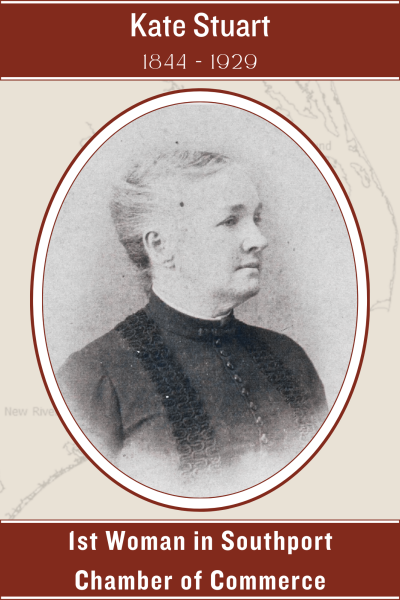
Kate Stuart was born in 1844 at the Stuart House, a boarding house her mother, Mary Garland Bensel, established in 1840. Originally named the “Water-Skirt Inn,” the boarding house was renamed after Mary’s second marriage to Dr. Charles Henry Stuart, Fort Johnston’s druggist. Shortly after Kate’s birth, Dr. Stuart abandoned the family, leaving Mary to raise her children and run the Stuart House, where Kate spent her childhood.
After attending the Thomasville Female College in Thomasville, North Carolina, Kate returned to Southport, then called Smithville, to help her mother manage the Stuart House, which became a place of refuge for travelers. Kate became known as the “Heroine of Smithville” after she saved the young daughter of Captain Alex Hunt from drowning.
Along with helping her mother at the boarding house, Kate taught at and served as principle of the Southport Academy. After her mother passed in 1884, Kate’s primary focus became operating the Stuart House.
The historic Stuart House in Southport is believed to have welcomed several distinguished guests over the years. Among those said to have visited were General Robert E. Lee, then a young brevet Colonel, who inspected the fortifications at Fort Caswell in 1840—placing him in the area during the home’s early days. Other notable visitors include Henry Bacon, the architect of the Lincoln Memorial; Daniel Russell and Zebulon B. Vance, both governors of North Carolina; and Reverend Joseph Ruggles Wilson along with his young son, Woodrow Wilson, who would later become the 28th President of the United States.
Kate was instrumental in preventing the county seat from being moved to Bolivia, an action that many in Southport were against. She was the first president of the Southport Civic Club, founded in 1909, a charter member of the Cape Fear Lodge of the Good Templars in 1875 and the Methodist Women’s Missionary Society in 1890. Kate was also the only female member of the Chamber of Commerce.
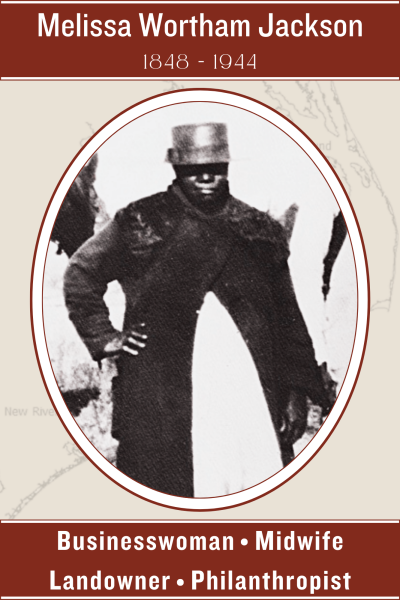
Melissa (Malissa) Wortham Jackson (1848–1944), affectionately known as “Aunt Malissa” or “Big Mama,” was a remarkable figure in Brunswick County’s history. According to family tradition, Melissa was born into slavery in Bladen County and, following emancipation, Melissa, her mother Faithie Wortham, and sister Celie Johnson journeyed by raft to Brunswick County, where she would build a lasting legacy.
In 1872, Melissa married John Jackson, and together they raised ten children. Despite having no formal education, she became a respected midwife under the tutelage of Dr. J. Arthur Dosher. Her entrepreneurial spirit flourished as she became one of the largest landowners in Brunswick County, purchasing around 800 acres of farmland. When no place of worship was available, she built a church on her own land — the foundation of what is now Brown’s Chapel AME Zion Church.
In addition to farming and midwifery, Melissa owned the shrimp boat Snap Shot, providing employment for many of her children. Her unwavering determination and contributions to her community made her a pioneering force, leaving a legacy of resilience, faith, and self-sufficiency.

Sarah McKenzie Evans Moore (1879–1940s) was one of the first African American women in Southport to receive a high school diploma, breaking barriers during a time of segregation and limited opportunities. With the support of her brother, who worked on a U.S. steamer, Sarah attended school in Elizabeth City, as Brunswick County had no schools for African Americans that went higher than seventh grade. By the late 1890s, she had completed four years of high school, setting a precedent for future generations.
In 1911, Sarah married James Moore, a marine engineer, and they made their home on Atlantic Street in Southport. Throughout her 45-year teaching career, she played a vital role in shaping the education of Black children in Brunswick County. Sarah retired in 1942, becoming the first person in Brunswick County to retire under the State Retirement System. Her dedication to learning and community upliftment made her a role model, laying the foundation for future Black graduates in the region. Sarah Mckenzie Moore’s legacy is a testament to the power of education, perseverance, an dedication.
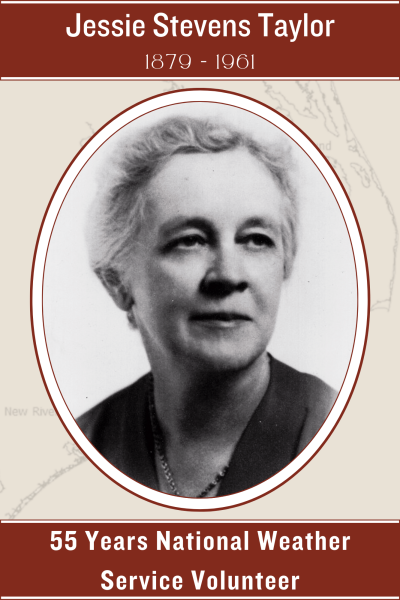
Born in Chicago in 1879 to Elizabeth and Enoch Stevens, Jessie’s family, including her mother, father, and four younger siblings, moved to Southport when she was ten years old. In 1902, the U.S. Weather Service constructed the 50-foot weather tower on the lawn of Ft. Johnston, overlooking the Southport harbor, and Jessie became the Volunteer Weather Observer, a position she proudly held for more than sixty years.
As Southport’s weather observer, Jessie took weather readings of temperature, precipitation and wind speed and sent reports to Washington, DC. In 1920 she also became the Storm Warning Display person, a role her father had previously filled, alerting vessels on the Cape Fear River and the local Southport community of hazardous weather conditions. During storms, such as the category 4 Hurricane Hazel in 1954 in which Southport lost all 20 of its fuel docks and shrimp packing houses, Jessie’s warnings helped keep local residents safe. In 1955 Jessie received an award in recognition of her long years of service from the U.S. Government and a commendation letter from President Dwight D. Eisenhower.
In addition to her weather service, Jessie was active in many community and civic projects that benefited Southport. In 1909 she founded the Civic Club of Southport, which aimed to improve the daily life and infrastructure of the town, serving as president five times between 1916 and 1946. As a member, Jessie was instrumental in establishing Southport’s first public library, which opened in 1912 in the Garrison House of Fort Johnston. After the passage of the 19th Amendment, Jessie worked to ensure women in Southport were registered to vote, empowering them to use their civic voice and take an active role in shaping their community’s future. The club still exists today and is known as the Southport Woman’s Club.

Born in 1890, Anna (Annie) Alene Clemmons became a trained nurse and worked in her community, providing medical care to residents of Southport and the surrounding areas. She lived in Southport for much of her life and continued her nursing profession even after experiencing periods of unemployment. Anna’s work as a nurse included her volunteer service during the 1918 influenza epidemic, a significant public health crisis in the U.S., demonstrating her commitment to the health and well-being of her community. She joined the Southport Red Cross during World War I.
Following the passage of the Nineteenth Amendment in 1920, which granted women the right to vote, Anna Clemmons was determined to exercise her right. Due to racial discrimination, however, she faced significant barriers in her attempt to register. Rather than give up, Anna Clemmons wrote a letter to the National Woman’s Party (NWP) explaining her difficulty in registering to vote in her county, despite her qualifications and civic engagement. She requested to register by mail, a method that would bypass the discriminatory practices of the local registrar. Anna was informed by NWP Secretary Emma Wold that they could not enforce the Nineteenth Amendment without the passage of an “enabling bill.” It wasn’t until the passage of the Voting Rights Act in 1965 that the Nineteenth Amendment became law, 45 years after it’s initial certification. Without the Voting Right Act, local registrars had the authority to deny registrants the ability to register to vote without explanation.
Her advocacy highlighted the racial and gender discrimination that continued to limit African American women’s participation in the democratic process, despite the legal recognition of their right to vote under the Fifteenth and Nineteenth Amendments.
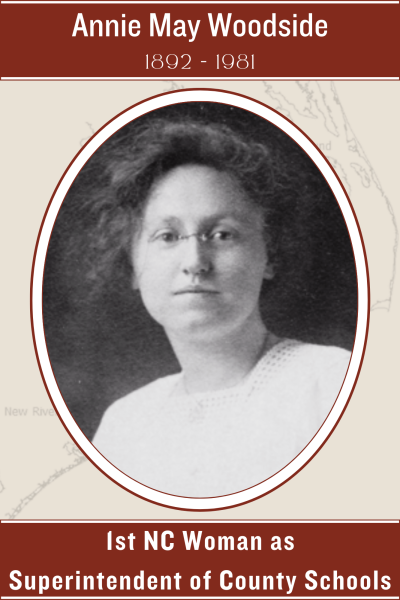
Annie May Woodside was born in Southport on September 26, 1892. Miss Annie May’s mother and father John and Mary Jane (Anders) Woodside had two daughters. Their older daughter, Mary Lizzie, died when she was less than four years old (1890-1894) .The following year Miss Annie May’s father died .
Mrs. Woodside and Annie May then lived with Mr. Woodside’s mother until the widow remarried 1901. Her new husband was a young pharmacist from Denmark, Jens Berg. He purchased a house for them on Bay Street in Southport. This house was the main part of the old Fort Johnston hospital. Annie May loved the house and as an adult researched its history and wrote about it. She.adored her stepfather and it was mutual. Dr. Berg adopted Annie May but she continued to use the Woodside name in honor of her grandmother. She inherited her money and property that her stepfather owned, but she lived very simply and used her wealth to help others. She lovingly provided a house and support for the woman who had served her mother for many years.
Miss Annie May’s education began in the building in Southport which now houses the Franklin Square Art Gallery, and continued at State Normal and Industrial College in Greensboro. She studied to be a teacher as did most women of her day who could afford to go to college. She taught for several years in Shallotte, but soon found that the business world had a greater appeal for her than her teaching at the time. She was then employed as cashier in what was the only bank, the Bank of Southport.
She never lost her love for the education world, though, and soon became the office assistant for the Brunswick County Supt. of Schools. When he resigned and moved away she applied for his job and was accepted. This was in 1935 in the midst of the trying days of the Great Depression, and at that time, she was the first woman who had ever served as Supt. of any school system in North Carolina. She steered the Brunswick County school system through the Depression and the crucial days of World War II until her retirement in 1947.
Miss Annie May was always active in the American Red Cross,serving in World War I with the title of Assistant for Military Relief and when World War II came along she became head of the Brunswick County chapter. Her responsibilities were many and complex, but she served faithfully. Also there was a severe housing shortage in Southport so she turned her grandmother’s house, which she had inherited , into three apartments for rent units. She was active in many civic and business projects in Southport and Brunswick County, but her first love was to the Southport Baptist Church which she had joined as a little girl. Here she served for many years in various capacities. Along with her other church jobs she served as Treasurer for more than 25 years.
Annie May was very interested in Southport history and was a charter member of Southport Historical Society.
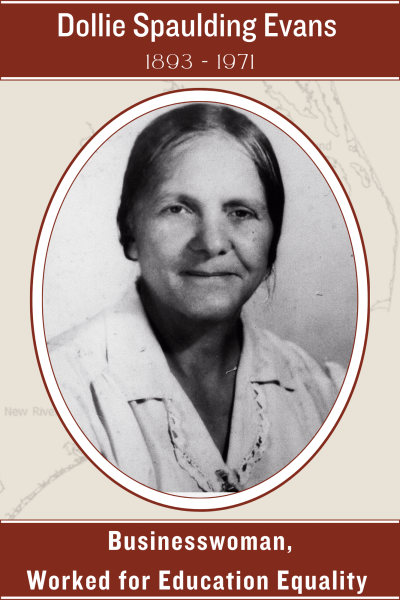
Born in Columbus County, NC on 28 Dec 1893 to Robert Owen Spaulding and Annie Jane Tucker. Dollie E. Spaulding married James Robert Evans and had 2 children. She passed away on 6 Aug 1971 in Dosher Memorial Hospital, Southport, NC.
She was a dedicated member of the St. James A.M.E. Zion Church in Southport. She was always willing to work and do her part. She had a love for politics and unselfishly exercised a significant political power during election time, which benefited her community.
Miss Dollie married Robert Evans, the first Black attorney in Brunswick County. They had one daughter. When her husband died in an automobile accident, she was left with the business of making a living and raising their daughter.
Not only was Miss Dollie a good businesswoman, she was a good mother. Her daughter, Annie, later became a teacher in the public schools in this county.
Miss Dollie was a frugal and hard-working woman, one of the first Black citizens in Southport with enough money to buy a new or new-looking car. When the depression hit in 1929, most everyone struggled, but this was especially true in the Black community. Miss Dollie was in the business of selling not only groceries, but also wood for fuel. She had an old Model T Ford truck that she used to go to a local sawmill for wood. At the mill, tall pine trees were cut for lumber, and Miss Dollie would load her truck with cast-off slabs. After returning to her wood-yard, she would proceed to cut the slabs into approximately eighteen inch pieces which she sold to the black community for cooking and heating. When Miss Dollie returned to her wood yard, she would take one of the back wheels off her model T truck. She then put a 4 to 6 inch wide belt around the axle of the truck and around a protruding arm from a large circular saw. When she jacked the rear of the truck off the ground and started the motor, the rear axle would tum and cause the leather belt to spin. The spinning would supply the power needed to make the circular saw tum rapidly, and Miss Dollie would use that spinning circular saw to cut her truckload of pine slabs into firewood. She would put the truck back into operation and deliver the load of wood.
It was hard work, but she never let that stop her. Cutting those pine slabs into firewood resulted in a lot of bark which would pile up near the saw. That was the bark Miss Dollie gave away. The bark was good for heating the kitchen cook stoves and iron space heaters used in the homes. It was also used to heat the iron wash pots that were used on Mondays to wash clothes. The bark, which Miss Dollie gave, not only provided the needed fuel to keep families warm in the winter, but also provided the fuel for those who earned a living doing the laundry for two or three families. Miss Dollie also performed farming operations in accordance with the needs and the times, and, otherwise, labored round-the-clock to earn her reputation as the “hardest working woman in town.”
There was no doubt that she was generous to a fault. She always included a little extra when she measured groceries from the stock barrels in the store. She knew how hard times were and she wanted to help as much as she could. Those whom she helped remember that she never took advantage of those who came to her store to buy groceries or to order a dollar’s worth of her wood for fuel. She no doubt helped many survive the depression.
The grocery store, owned and operated by her, was a local gathering place for some of the older people in the community. There, the old soldiers or sailors would talk and reminisce about Roosevelt or his Rough Riders, etc., while butterbeans, green peas or other vegetables were being shelled. Miss Dollie would eventually have those vegetables loaded in a wagon which her one-eyed horse Henry would pull to the big houses along the riverfront where they would be bought by cooks or other domestic help. When Miss Dollie decided to add an upstairs porch to her store, Mr. Ed Swain was given the job. When the new upstairs porch was completed, those attending Mr. Wilson’s juke box parties had more courting privacy. The upstairs was where James Wilson, a janitor at the black school and a Sunday school superintendent, used to arrange parties for the young people from the community. Mr. Wilson would feed nickels into the machine during his parties; but there was also an old piano in the upstairs of that store, and sometimes Mr. Wilson would hire Patty Moore to come and play the piano. Patty could not read a note, but he could make that piano talk. In the earlier years, when dancing was not allowed in school, the proms were held at her restaurant.
Anna P. Miller Davis (1894–1974) was a pioneering figure in Brunswick County, recognized as the first woman in the county to register to vote following the ratification of the 19th Amendment. Born in New York to German immigrants Elizabeth and Leonhard Miller, Anna moved to Southport where her family became prominent in the local hospitality business.
In 1909, Anna’s father and brother built the Miller Hotel at the corner of Bay and Howe streets. Anna married David Monroe Davis in 1918, and the couple took over ownership of the hotel in 1920. They lived on the second floor with their two children, Leonard and Elizabeth, while operating the hotel’s popular café, soda fountain, and hosting Saturday night dances — making the Miller Hotel a social hub in Southport.
Anna’s historic voter registration marked a significant moment for women’s rights in Brunswick County. In October 1920, she presided over the first citizenship lecture at the Army and Navy Club, where she introduced speakers and encouraged women to exercise their newfound voting rights.
Anna Miller Davis’s legacy as a businesswoman, community leader, and advocate for women’s suffrage remains an important part of Southport’s history.

Mary Eliza Williams Wortham was born in 1885 to Amanda Houston and Caana Williams. In 1905 she married George “River Legend” Wortham. They had three children.
Wortham was a trained midwife, who played a crucial role in the health care of her community in Brunswick County, North Carolina. She trained under Dr. J. Arthur Dosher, a prominent local physician. She worked closely with him and the Brunswick County Health Department. Over the course of her career, she delivered more than 500 babies, providing essential maternity care to families in the area, particularly at a time when medical care and access to hospitals was often limited due to racial and socio-economic disparities in the region. As a midwife, Wortham provided not only delivery services but also prenatal and postnatal care. Her role was vital in helping families navigate the complexities of childbirth and early child-rearing.
Among the babies that Wortham delivered were several of her own grandchildren. When one of her daughters passed away at a young age, Wortham took her grandchildren into her home on W. St. George St., and raised them. Her granddaughter Ennis Tobler, who lived with her grandmother from the age of 12, remembers her grandmother’s work as a midwife. According to Ennis,
“People would knock on their door at all hours of the day and night. They would come to get her when the baby was coming. There would be a knock on the door, and the words, “Miss Mary – it’s time”. It didn’t matter if it was early morning or late at night. My grandmother would get her bag and go. If they were coming from Bolivia they would have a car. They’d wait for her and drive her. But if they were from Southport, she’d usually walk. She did a lot of walking. She’d be gone a day, sometimes two. Our grandfather would stay with us when she was gone.
She wore a white apron and white shoes when she did her work. She was always neat. When she came home she’d tell me about the baby. I don’t recall that she ever lost one. She never learned to read or write but she knew a lot about delivering babies. She was very good with the mamas and the babies. She loved her job and she was good at it.”
Wortham’s long tenure as a midwife speaks to her dedication to her craft and the trust the local community placed in her abilities. Through her work, she touched the lives of hundreds of families, ensuring safe childbirths in a time when many families had limited access to healthcare resources.
Miriam Odell Gore Lane, known to her family as Peaches, was born December 7, 1903 to Alexander Snouden Gore, 25, and Lillie Mae (Parker) Gore, 20. She had five sisters and ten brothers, including Elias “Nehi” Gore, widely known for his remarkable size and strength. He helped to send several of his siblings to college.
Miriam and her family were members of Mt. Carmel AME Church. Through the efforts of her brother Elias and the support of the church Miriam was able to get a high school diploma. This was unusual for Black students in Southport as there were no schools for Black students that went over the 7th grade in all of Brunswick County.
Miriam traveled to Vance County to attend Kittrell College, an AME school. When she graduated from there with her high school diploma, she went on to Elizabeth City Normal School where she got a teaching degree. She graduated from a two-year program on May 27, 1927.
After graduation, she became a Jeanes Supervisor for Brunswick County schools, a job that required her to travel all over Brunswick County overseeing curriculum, advising teachers and monitoring student progress.
Miriam later taught at what is now, Hampton University, Virginia Union University and Virginia State University. Miriam was the Elementary Education Department Head and was in charge of the Reading Clinic at Virginia State College. The Reading Clinic was designed to assist those students entering college that required assistance with learning to read effectively and learning to speak English correctly.
She married Tarsus Devaughn Lane of Apalachicola, Florida. Lane was a graduate of Hampton University and Penn State. He taught tailoring at Virginia State College. Miriam and Lane kept a summer home in Southport. Much of their time was spent on their boat, Miriam G. They were avid fishermen and the first Black boatowners to have a slip at the marina. The couple retired from teaching in 1966 and moved to Daytona Beach, Florida.
Southport was still home and they returned often. Miriam returned to Southport a final time after her husband’s death. She built a new home in Southport on St George Street. Miriam Odell Gore passed in October of 1986. She and her husband are interred at Northwoods Cemetery.

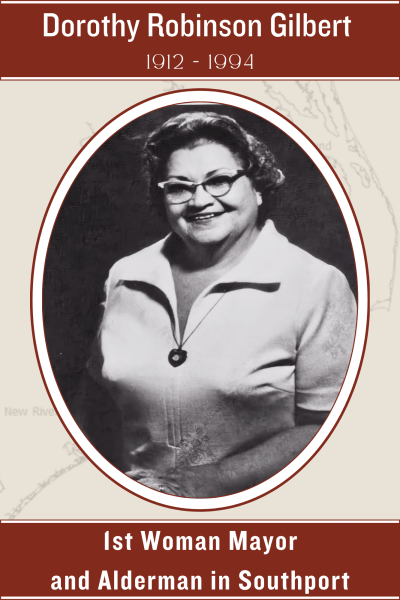
Dorothy Robinson Gilbert, born September 25, 1912, was a dedicated civic leader whose contributions left a lasting impact on Southport. Born in Brunswick County to G.D. and Elizabeth Galloway Robinson, she married James Alton Gilbert, with whom she had two sons and two daughters.
Dorothy’s political career began in 1966 when she was appointed to the Southport Board of Aldermen following the passing of her husband, Mayor J.A. Gilbert. In 1971, she made history by becoming Southport’s mayor, completing the term of the late Mayor Lester Lowe. Her leadership marked a significant moment in the town’s history.
Beyond politics, Mrs. Gilbert was an influential figure in local healthcare and civic organizations. She served on the Board of Trustees for Dosher Memorial Hospital and The Brunswick Hospital, was a past president of the Dosher Hospital Auxiliary, and played a key role in organizing the Dosher Volunteers. Her dedication to community service extended to the Southport Garden Club, Southport Woman’s Club, and Southport Baptist Church.
Additionally, she participated in musical tributes through the county arts council and owned both a florist and beauty shop. Dorothy Robinson Gilbert’s commitment to public service, healthcare, and the arts enriched the Southport community and set a powerful example of leadership and compassion.
Margaret Stevens Taylor was born on February 17, 1917, in Southport to Charles Edward and Jessie Stevens Taylor. Margaret earned her bachelor’s degree from Greensboro College in 1937. She married James M. Harper Jr. on November 25, 1937, in her hometown. They had two children during their marriage.
Margaret Taylor Harper was a distinguished journalist, businesswoman, and civic leader, her multifaceted contributions spanned journalism, politics, community service, and education.
Following her marriage to James M. Harper Jr., editor of the State Port Pilot, Margaret played a pivotal role in the newspaper’s operations, especially during World War II when her husband served in the U.S. Navy. She also managed the Stevens Insurance Agency, founded by her grandfather. Her dedication to journalism was further evidenced by her tenure as executive secretary of the North Carolina Press Association from 1969 to 1978. In 1987, she was inducted into the North Carolina Journalism Hall of Fame.
In 1968, Margaret became the first woman in North Carolina to run for a statewide public office. She sought the Democratic nomination for lieutenant governor, securing 22% of the vote and carrying five counties. She pursued the nomination again in 1972.
Her civic involvement included leadership roles such as president of the North Carolina Democratic Women, chair of the North Carolina Council of Women’s Organizations, and service on the Board of Trustees for the University of North Carolina at Chapel Hill.
A devoted member of Trinity United Methodist Church in Southport, Margaret served as a Sunday school teacher and organist for over 50 years.

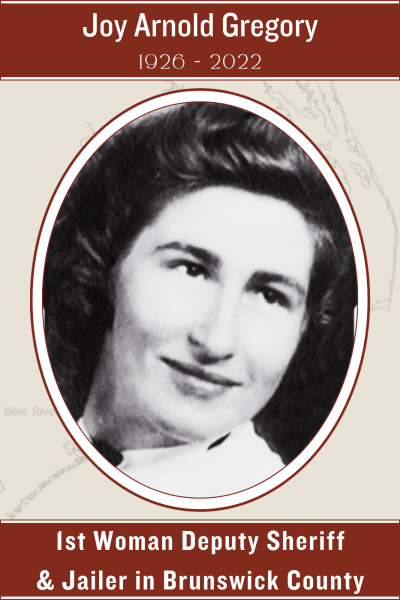
Joy was born on December 3, 1925 in Southport, NC. She was the daughter of the late James Samuel Arnold and Bertha Fulford Arnold.
During WWII, Joy volunteered as a Jr. hostess at the Southport USO. It was there that she met the love of her life, George Gregory, whom she married when she was 16 years old. When George went overseas with the Navy, Joy did her part for the war effort by becoming a tig welder at the Wilmington shipyard where she helped to build liberty ships.
Following the war, Joy went on to serve in various capacities within the Brunswick County government, including Clerk of Court and Social Services. In a groundbreaking move, she became the first female Deputy Sheriff and jailer for Brunswick County. She also ran several small businesses including a bar, a trailer park, and a dress shop.
Beyond her professional duties, Joy was deeply committed to volunteerism. She dedicated many years to volunteering at Dosher Hospital in Southport, reflecting her caring nature and dedication to the well-being of her community.
Joy was married to George Gregory for 60 years, and together they had two daughters, Rose McKeithan and JoAnn Overby.
Joy’s life was marked by a blend of professional achievement and heartfelt community service. Her contributions left an indelible mark on Southport, and she is remembered fondly for her dedication to both her family and her community.
Ludelphia “Nunnie” Bellamy Rogers (1927–2007) was a dedicated community leader and civil rights activist who played a pivotal role in the fight for equality in Southport. In 1963, she helped establish the Southport branch of the Brunswick County NAACP after being approached by a gentleman who had worked with Dr. Martin Luther King, Jr. Recognized for her leadership, Rogers attended a workshop in Durham to learn how to organize the chapter, serving as its first secretary.
Under her guidance alongside her husband, Charles Rogers, the NAACP chapter became a driving force for change. The couple spearheaded the formation of the Youth Council, encouraging young people to advocate for justice through peaceful demonstrations. The chapter’s early efforts were instrumental in integrating Brunswick County Schools, securing equal access to hospital rooms at Dosher Hospital, and eliminating the use of separate tax books and Bibles for Black and white citizens at the county courthouse.
Through the NAACP’s advocacy, Southport saw the election of the first Black public officials and increased job opportunities for African Americans in local government and businesses. Ludelphia Rogers’ unwavering commitment to civil rights left a lasting legacy of progress, equality, and empowerment for the community of Southport.